 Skip to content

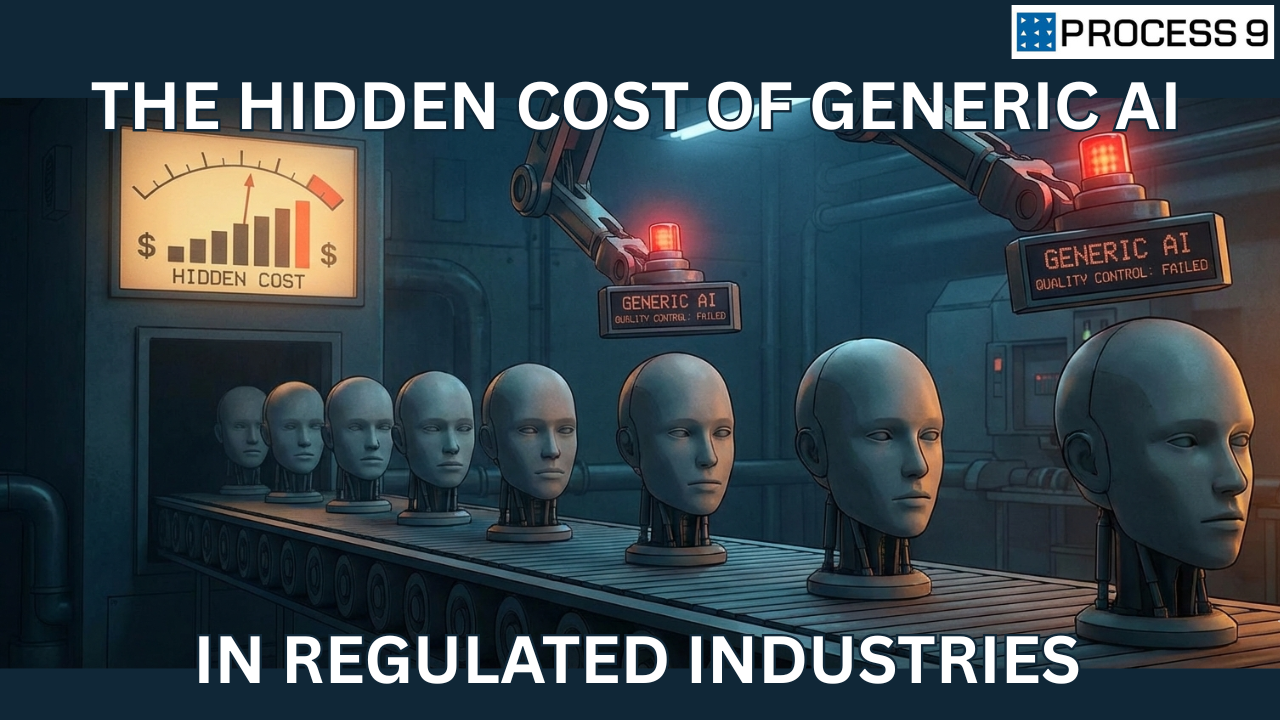
Why sharp, purpose-built intelligence will outlast all-knowing models
For a while, it seemed inevitable. As large language models grew in size and capability, the assumption was that they would gradually absorb all enterprise complexity. More parameters, larger context windows, better prompting, and enough fine-tuning would eventually produce a universal problem solver.
In theory, it was elegant. In practice, it has been fragile.
Across regulated enterprises, we are seeing a widening gap between what generic AI promises and what production systems require. The challenge is not whether models can generate responses. The challenge is whether they can do so reliably, predictably, and safely in environments where the cost of error is high and the tolerance for ambiguity is low.
This is where many early AI strategies are starting to strain. Not because the models are weak, but because the architecture is wrong.
Enterprise complexity is not just large. It is layered, risk-sensitive, and governed. Systems are not judged by how much they know, but by how consistently they behave.
And that is a very different design problem.
How Generic AI Breaks In a Regulated and Multilingual Environment
The limitations of one-size-fits-all AI become most visible in regulated, multilingual environments. In these systems, language is not just a medium. It is a signal.
We routinely see user inputs that look simple on the surface but carry very different implications depending on context. A query such as “Will I be charged for using my flagged card?” may appear straightforward. In Indian language settings, however, “charged” is often interpreted as कानूनी कार्यवाही, meaning legal action, when the user is actually asking about शुल्क, meaning fees.
A generic model will often handle this as a translation task. In a regulated system, it is a risk classification task.
The difference matters. A response that implies legal action can cause panic and reputational damage. A response that downplays a legal risk can create compliance exposure. The words are similar. The consequence is not.
We see this pattern repeatedly in multilingual workflows. Code-mixed inputs, regional phrasing, and colloquial expressions often carry intent that is not explicit in the text. In collections, support, and claims journeys, users rarely speak in clean, formal language. They hint. They imply. They soften. They escalate indirectly.
Generic models, trained on broad, global datasets, tend to normalise these signals. They treat nuance as noise. In comparison, for regulated environments, nuance is not noise. It is the early warning system.
This is why language handling cannot be separated from risk handling. And why AI systems that are not designed for domain context struggle to behave correctly, even when they appear linguistically accurate.
Regulated systems do not fail loudly. They fail subtly. And subtle failures are the most expensive.
The Efficiency Myth and the Physics Constraint
There is another reality that is often missing from AI strategy discussions – physics.
Large models require large compute. That is not an abstract constraint, rather it is a practical one. GPU availability is already tight. Enterprise access is inconsistent. Costs are rising faster than business value. Energy consumption, heat dissipation, and water usage are becoming operational considerations, not theoretical ones.
We are seeing organizations invest heavily in AI infrastructure with no clear path to sustainable ROI. In many cases, the model is impressive, but the economics are fragile.
As usage scales, so do costs. As prompts grow, so does latency. As workloads increase, so does infrastructure dependency. The promise of intelligence collides with the reality of capacity.
This creates a quiet but serious problem. AI systems that are too expensive to run, too slow to respond, or too unpredictable to trust do not become strategic assets. They become liabilities.
In regulated, high-volume environments, predictability matters as much as performance. Systems need to be available, stable, and cost-controlled. Designing architectures that depend on massive, always-on compute for narrow, repetitive workflows is not efficient. It is wasteful. This is where the industry’s early enthusiasm is meeting operational gravity.
Not every problem needs a supercomputer. And not every decision needs a universal brain. Sometimes, the right design is the simpler one.
Why Specialisation Wins in Regulated Systems
One of the most persistent misconceptions in enterprise AI is that broader capability is always better. That a model that can answer more questions, across more topics, in more ways, is inherently superior.
In regulated environments, the opposite is often true. Here, the goal is not to maximise coverage. It is to maximise correctness within defined boundaries.
A model that can handle ten workflows imperfectly is less valuable than a model that can handle one workflow with high precision, high consistency, and high confidence. This is not a limitation. It is a design principle.
Specialised models allow you to:
- train on focused, high-quality datasets
- control behaviour more tightly
- test more rigorously
- and govern more effectively
They reduce the surface area for error. They make evaluation meaningful. They make drift detectable.
Most importantly, they make behavior predictable. In regulated systems, predictability is not a nice-to-have. It is the foundation of trust.
This is why purpose-built models consistently outperform general-purpose ones in production. Not because they are more intelligent, but because they are more aligned.
They are designed for the job they are doing.
Why Behaviour Matters More Than Capability
A lot of AI discussions focus on what models can do. How many languages they support. How many tasks they can perform. How flexible their responses are.
In regulated systems, those metrics are secondary. What matters is how the system behaves under pressure.
- How it responds to ambiguity.
- How it handles edge cases.
- How it escalates when it should.
- How it refuses when it must.
A system that occasionally fails to respond is manageable. A system that responds confidently and incorrectly is dangerous.
This is why behavior design is central to enterprise AI architecture. The model is only one component. The workflows, guardrails, escalation paths, and validation logic are equally important. When AI is embedded into core journeys such as onboarding, claims, collections, or customer servicing, it becomes part of the decision-making fabric of the organization. At that point, unpredictability is not innovation. It is risk.
This is where many early GenAI experiments struggle to graduate into production. They work well in demos. They perform inconsistently in real-world conditions. And when they fail, they fail quietly.
Enterprise systems cannot afford quiet failures.
Language Is Not a Layer. It Is a Control Surface.
In multilingual markets, language is often treated as a presentation problem. Translate the interface, localize the content, add subtitles and move on.
In regulated systems, this approach breaks down quickly. Language is not just how information is delivered. It is how intent is expressed. How risk is signaled. How emotion is conveyed. How compliance is interpreted.
When a user mixes languages, softens phrasing, or uses colloquial expressions, they are not being imprecise. They are being human. Systems need to be designed for that reality.
We see this repeatedly in Indian BFSI environments. Users switch between languages within a single sentence. They use regional idioms to describe financial stress. They avoid direct language when discussing sensitive topics. They imply rather than state.
A generic model may translate these words correctly. It often misreads the intent.
This is why we believe language must be treated as infrastructure, not as a layer. It must be embedded into workflows, not bolted on. It must be governed, tested, and monitored like any other critical system component.
If your core systems are real time, your language systems must be too. Anything else creates lag, mismatch, and risk.
What This Means in Practice
This design philosophy is not theoretical for us.
We are building voice agents for the finance industry that are designed around well-defined, high-confidence workflows. Investment calculators. Loan eligibility checks. Outbound calls for specific products. Structured onboarding journeys.
Each of these systems is designed with:
- clear scope boundaries
- explicit escalation paths
- strict response guardrails
- and controlled behaviour patterns
They are not designed to “chat”. They are designed to perform.
These systems are engineered for high-stakes conversations and strict compliance
| Feature | What it Means For The Business |
| Linguistic Intelligence | Handles code-mixing and diverse dialects without breaking the flow. |
| Structured Workflows | Purpose-built for calculators and eligibility – not for hallucinations. |
| Conversational Data Collection | Replaces tedious forms with natural Q&A to boost completion rates. |
| Empathetic UX | Responds with context-aware tone, making automated finance feel human. |
| Compliance Guardrails | Strict boundaries ensure security; sensitive issues are seamlessly escalated. |
We also design these systems to handle:
- code-mixed language
- regional accents
- different ways of asking the same question
- and culturally specific expressions of intent
Because in regulated environments, trust is not built through novelty. It is built through familiarity and reliability.
A system that sounds natural, understands local context, and behaves consistently is far more valuable than one that can answer everything in perfect English.
This is where specialised models, combined with strong orchestration and guardrails, create real enterprise value.
The Maturity Phase of Enterprise AI
Across sectors, the initial euphoria around GenAI is giving way to more grounded thinking. This is not a sign of failure. It is a sign of maturity.
Organisations are moving from experimentation to evaluation. From pilots to production. From possibility to practicality.
This is where architecture starts to matter.
The future of enterprise AI will not be built on one-size-fits-all models and unbounded prompts. It will be built on sharp, focused, governed systems that are designed for specific outcomes.
Precision will outperform breadth.
Design will outperform scale.
Behaviour will outperform capability.
The organisations that recognise this early will build AI systems that are stable, trusted, and economically viable. The ones that continue to chase generality without structure will struggle with cost, risk, and credibility.
That is the hidden cost of generic AI.
Final Thoughts
Generic AI is impressive. Specialised AI is reliable. In regulated environments, reliability wins.
The question is no longer whether AI can generate responses. It is whether it can do so correctly, consistently, and safely at scale.
This is not a model problem. It is a design problem.
And it is the problem serious enterprises are now solving.
Read abridged version here.





Share: